When to Remove a Tree vs. Save It: 7 Signs You Shouldn't Ignore
Not every sick-looking tree needs to come down. Here are seven specific warning signs that push a tree from 'save it' to 'remove it' — and how to tell the difference.

Quick Answer
Quick Answer
A tree should typically be removed when it shows: dead canopy above 30%, structural decay or hollow trunk, a dangerous and increasing lean, root-system uplift, split trunk or major failure, proximity hazard to a structure or utility line, or declining health across multiple seasons. Restoration pruning, cabling, or bracing may save trees with only one or two issues.
- Try to save if
- 1 – 2 issues
- Remove if
- 3+ issues or structural
- Cost to remove
- $450 – $3,500+
- Cost to save
- $250 – $1,500 (pruning / cabling)
1. More than 30% of the canopy is dead
A healthy deciduous tree in Massachusetts should leaf out fully each spring. If more than 30% of the canopy stays bare, shows die-back from the tips inward, or carries a disproportionate share of dead branches, the tree is in decline that pruning alone cannot reverse.
Below 30% dead wood, a crown-cleaning can restore health dramatically. Above 30%, the tree is losing its photosynthetic capacity faster than it can grow replacements, and removal is usually the right call.
2. Structural decay or a hollow trunk
Carpenter ants. Sawdust at the base. Visible fungal conks (hard mushroom-like growths) on the trunk. A hollow sound when you knock. These are the signs of internal decay — and they're cumulative.
A certified arborist can sound the trunk and estimate remaining sound wood. When more than one-third of the trunk's cross-section is compromised, the tree's structural reserve is gone and a wind event can fail it without warning. That's a removal.
3. A dangerous lean — especially one that's increasing
Trees that have always leaned aren't the problem. Trees that are leaning more than they did last year are. A lean that's increased visibly in 12 months often signals root-system failure below ground — the soil has let go, and the tree is rotating.
Look for soil heaving or cracking on one side of the trunk (the side opposite the lean). That's the root-plate failure signature. Once you see it, the tree is weeks or months from falling, not years. Remove it before a storm removes it for you.
4. Major storm damage — split trunk or large failed limb
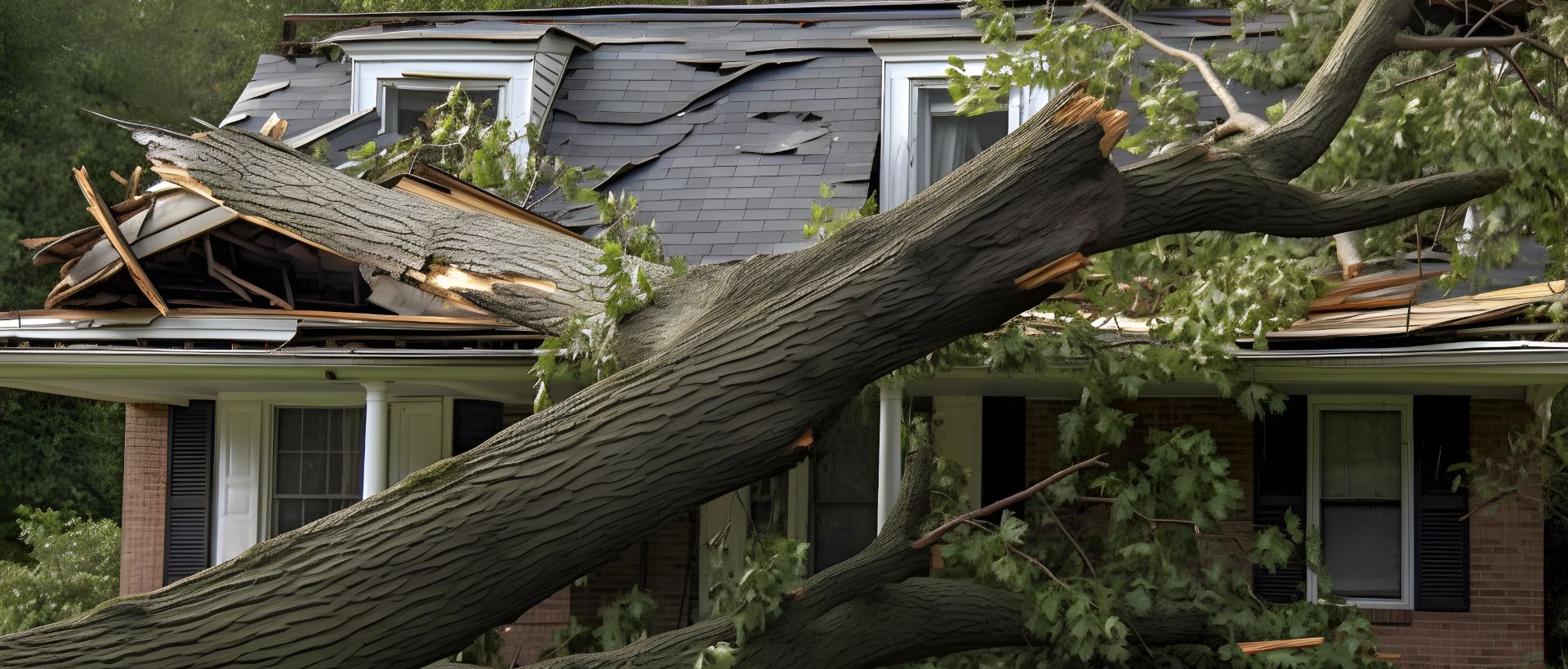
Massachusetts storms do two kinds of tree damage: limb loss (often survivable with restoration pruning) and trunk splits (usually not). A trunk split that reaches into the heartwood cannot heal over. The tree compartmentalizes the damage as best it can, but decay fungi invariably invade the exposed wood.
If the split is superficial (outer inches of sapwood) and the tree is otherwise vigorous, restoration pruning might preserve it. If the split reaches the pith or creates two separated leaders, the tree is structurally compromised and removal is safer.
5. Proximity to a structure or utility line
A tree can be perfectly healthy and still need to come down because of where it is. A mature red oak that has grown into a power line, or a white pine leaning toward a kitchen bedroom window, or a silver maple crowding a foundation — these are hazard positions, not hazard trees.
In many cases, major crown reduction or directional pruning can buy you 5–10 more years. In others, the only real fix is removal. A good arborist will tell you honestly which category you're in.
6. Declining health across multiple seasons
A tree that produced a half-sized canopy last year, then half that this year, then shows dead tips this fall — that downward trajectory almost never reverses. Drought stress, compacted soil, girdling roots, or internal decay compound each other, and the tree is dying even if it's not yet dead.
If you document decline across 2–3 growing seasons and arborist intervention (deep watering, mulching, pruning) doesn't stabilize it, removal is usually the economical and safe move.
7. Professional arborist recommends removal
This sounds obvious, but it matters: if an ISA-certified arborist with no financial incentive to inflate the job tells you a tree should come down, take that seriously. Most reputable tree companies will recommend saving a tree when it's savable — every removal they don't do is a removal some other company will. When a good arborist says remove, there's usually a reason that's not in the glossy marketing material.
Ask what specifically they saw, and what alternatives they considered. An answer like 'it just looks bad' is a red flag; an answer like 'the trunk has >40% decay on the north face and the lean increased 8° in 18 months' is the real signal.
Keep Reading
Related Guides
Pricing
How Much Does Tree Removal Cost in Massachusetts? (2026 Guide)
Tree removal in Massachusetts runs $450–$3,500+ per tree, with most jobs falling between $750 and $1,800. Here's what drives the range, when to bundle, and how to get a fair quote.
Insurance
Does Homeowner's Insurance Cover Tree Removal in Massachusetts?
Homeowner's insurance covers tree removal when — and only when — a tree has actually fallen on a structure or blocks essential access. Here's exactly when it applies and how to document a claim.